Secrets of Jupiter's Great Red Spot Revealed - Newsweek

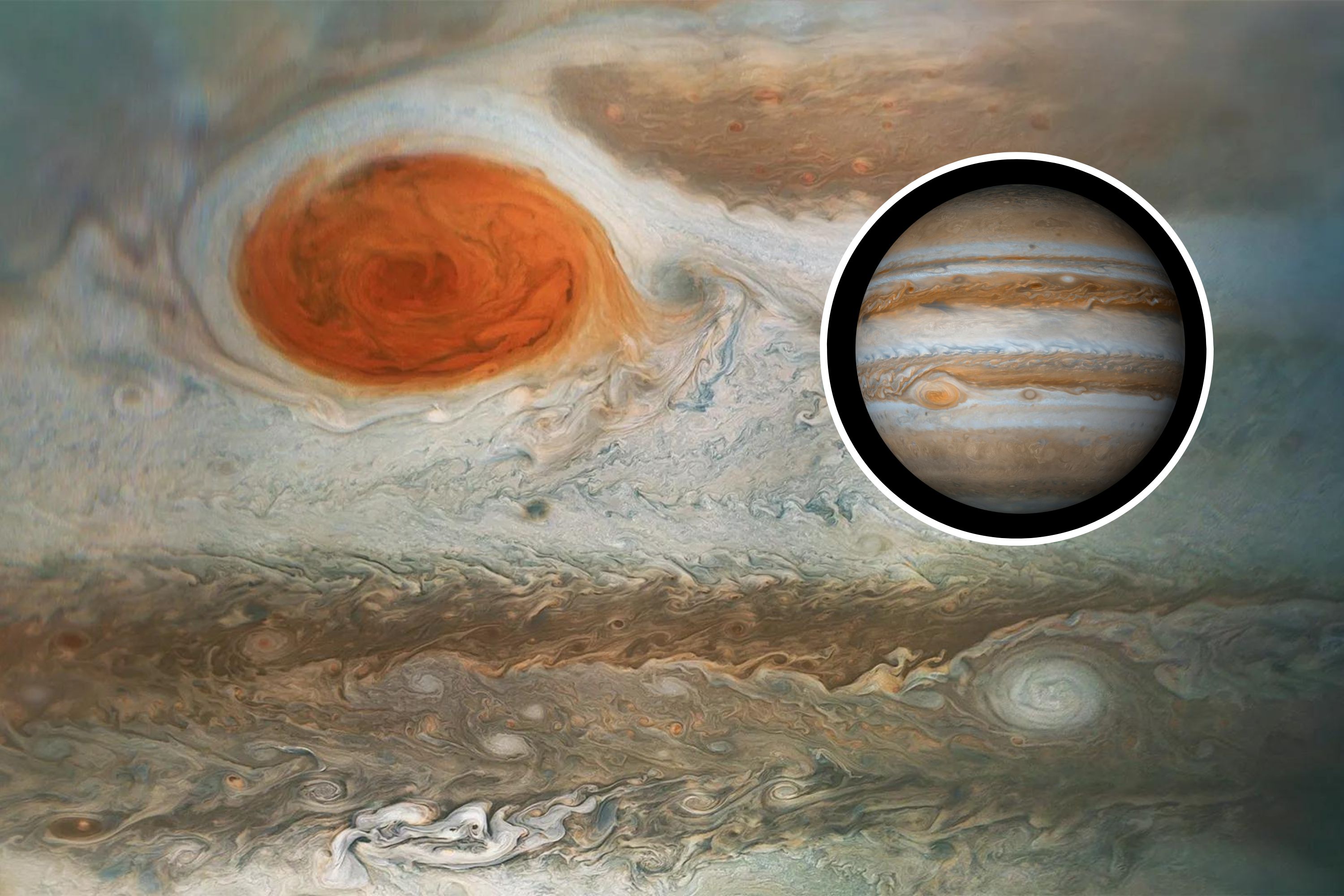
Jupiter’s Great Red Spot is a colossal, high-pressure anticyclonic vortex wide enough to swallow Earth, powered by internal planetary heat and sustained by consuming smaller storms. While humanity has tracked this iconic crimson tempest for centuries,

 
The Anatomy and Scale of the Beast
    • Staggering Depth: Microwave radiometer data from Juno reveal that the Great Red Spot roots down more than 200 miles (350+ kilometers) into Jupiter’s atmosphere, making it vastly deeper than any terrestrial ocean or storm. [1, 2]
    • Shrinking Yet Growing Taller: While the storm has steadily contracted horizontally over the past century—shrinking from over three Earths wide down to roughly a single Earth diameter—it is simultaneously growing taller, acting like clay squeezed on a potter’s wheel. [1, 2, 3]
    • Surprising Speed Changes: Hubble measurements show that while the core rotation remains steady, the winds in the storm’s outer lanes have actually accelerated by up to 8% over recent years. [1]


Unresolved Mysteries of the Red Spot
    • The Color Puzzle: Scientists still debate the exact chemical mechanism behind its crimson hue. The leading theory suggests colorless ammonium hydrosulfide particles rise from deeper layers and undergo chemical reactions when bombarded by solar UV radiation or cosmic rays. [1, 2, 3]
    • Atmospheric Superheating: Although the upper cloud tops of the storm are bitterly cold (around minus 256°F), the atmosphere above the Great Red Spot reaches scorching temperatures near 2,400°F—hotter than Earth’s lava. Astronomers believe acoustic and gravitational waves surging upward from the storm’s violent turbulence superheat the upper layer. [1, 2, 3]
    • Age and Permanence: Recent computer simulations suggest the current storm may be a younger vortex that formed within the last 150–190 years, replacing an earlier “Permanent Spot” observed by Giovanni Cassini in the 17th century that likely faded and vanished. [1, 2]


Would you like to learn more about how Jupiter’s jet streams lock the storm in place, or explore the inner workings of Juno’s microwave radiometer? [1, 2]
Why do we use it?


Leave a Reply

Your email address will not be published. Required fields are marked *